The Cracker Chronicles

About the Chronicles

Full Disclosure and Partial Disclaimer

So, I’m a writer and storyteller.  Some things I write become songs, others are just stories from my family and my past that have been collected, told and retold over the years.  The stories you’ll read here in The Cracker Chronicles are true.  Well, mostly true.  I’d certainly say there’s truth in each one, to some degree.  Clearly nothing is an outright lie, though some liberties with the actual facts may have been taken.  I’m sure you're starting to get the picture.   In any event, these stories are all mine and no form of data center building AI has been used in creating them in any way.  Some are amusing, some are touching and all are part of my past and who I am.  I hope you enjoy them!

The Clay Pit 

    Our family farm in Lake County, FL, west of Leesburg on highway 44, was small, about 33 acres in size.  The neighbor to the west was Earle Hester (Mr. Earle), who had 40-50 acres that ran all the way to Whitney Road in front of the old Whitney Baptist Church, where Grandma Spears often hauled me for Sunday services when she was put out with the folks at First Baptist in Leesburg.  We used Mr. Earle’s property, by agreement of course, to pasture cattle and to hunt on.  Our farm and Mr. Earle’s property were my domain every summer and any other break in the school year that was more than just a weekend.

    Farm ponds are a wonderful and necessary thing.  You gotta have water.  Recreationally, they were swimming holes, fishing spots and just places to hang around and see what mischief you could scare up.  Some were more inhospitable than others and the old clay pit ranked right up there.  It was exactly as the name implies, a pit originally dug to extract clay to use as the subbase for the old abandoned roadway (wagon and horse path really) that originally ran through our farm and Mr. Earle’s place out to where Whitney Road intersected the “new” highway 44.  The pit was probably 100 feet across, fairly round, and was thirty feet or more deep.  It had been dug deep enough to strike water, which kept it filled to a certain level, and it also served as a collection area for rain runoff, etc.  Huge oak trees shaded it on two sides and our little orange grove (about three acres or so) lay on the south side between the clay pit and highway 44.  The sides were steep and my earliest memories include stern admonitions to stay back from the edge of the pit since me falling in would entail a rescue operation that would be most inconvenient and would likely earn me a serious whippin’ (that’s like a spanking, but with a bit more effort invested).

    Over time, the clay pit had accumulated (with some managerial encouragement) a thriving population of bluegill bream, warmouth perch, small bass and catfish, making it a frequent afternoon and evening fishing retreat for Uncle Claude and me, often joined by Mr. Ed (not the tv talking horse, the man that rented the little house on the front of Mr. Earle’s property out by the highway).  We’re talking long cane pole, worm, cricket and minnow fishin’ here, nothing fancy whatsoever.  But to me it was pretty darn cool.

    To keep it useable, the clay pit required a fair amount of maintenance.  We tried to keep a good ten to twenty feet around it mowed, primarily to eliminate hiding places for snakes, which enjoyed the clay pit as much as I did.  I had a moccasin that had to be six feet long and as big around as my arm slither right across my feet one evening as I made my way around the edge.  Yep, I was definitely down with the mowing!  Weed eaters weren’t invented yet, so we had to use a sling blade and / or a sickle to clear the edges of the bank.  Occasionally, when the growth and debris got too determined, we’d burn the inside edges of the bank down to the water line.  It was a constant struggle, but all well worth the effort for the treasured opportunity to wage war with a scrappy bluegill on a limber cane pole.

    The more troublesome issue was vegetation growth down in the water itself, primarily lily pads.  The pads are a good thing for the pond in controlled quantities (and pretty when the lilies bloomed), but left unchecked they choke the surface and can eventually kill the pond.  As I mentioned, the banks of the clay pit were very steep, so climbing down there to work on the pads just wasn’t in the cards.  But cracker ingenuity is real, particularly if fishin’ is at stake!

      We took some rusted triangular steel tiller points off of an old mule drawn plow that was never going to be used again, sharpened them on the foot powered grind stone and bolted them (about five or six) to a length of flat iron bar.  To the ends of the bar, we attached a long piece of metal, bent to a V shape, where we could tie a long nylon cord (one of the technological wonders of WWII).  This allowed us to stand high on the bank of the clay pit, throw the bar of sharpened plow points attached out into the middle of the water, let it sink, then pull it back (not easily I might add), cutting the lily pads down deep as it came.  It worked great and after an hour or two of pitching and pulling the surface of the water was covered with cut pad stalks and leaves.

    But now what?  You couldn’t fish through that mat of cut lily pads any better than you could live ones.  It was a mess!  Again, getting down those steep banks to the water to reach and gather the debris wasn’t in the cards.  Another as yet un-invented implement was needed.  Back to the cracker drawing board.

    We took a length of 2x4 lumber and attached the same kind of V shaped metal rig where we could tie another long nylon cord (lots of war surplus items readily available in those days).  Into one side of the 2x4 we drove a row of ten penny nails, forming teeth like a common rake.  The idea was that when tossed out across the water the wood would float and the nail teeth would snag the cut lily pads, raking them to the edge where we could drag them up out of the pit.  Genius!

    Now, this is all happening when I’m probably 7-8 years old and while I’m right there in the thick of things helping in any way I can, most of this ingenuity is originating from Uncle Claude and Mr. Ed.  I’m the helper, the “go fetch it” and “hold this right there” arm of the enterprise.  I hadn’t been elevated to skilled labor or design consultant as yet, though I did get to hammer in some of those nails.

    The long reach water rake invention suffered from a serious design flaw.  At least 50% of the time we tossed it out it landed with the teeth pointed up – not good.  Uncle Claude and Mr. Ed puzzled over the problem, devising solutions that involved adding weight to the tooth side of the 2x4 to encourage it to land on that side when tossed, bending the V attachment point for the rope to try to control the toss better, any number of complex strategies to eliminate variables, increase control and improve the odds of the thing landing tooth side down as intended.  As they were muttering and scratching their heads I said simply, “why don’t we just put the nails on both sides of the 2x4?”  Uncle Claude and Mr. Ed had never looked so sheepish.  They seemed genuinely torn between hugging me and drowning me.  My position in that cracker crew was elevated a bit thereafter.

    With the problem of periodically cutting and removing the lily pads from the clay pit solved, we happily fished that little water hole for years to come.  Dad and Aunt Etta sold the farm to a commercial developer in 2007 just before the big real estate bust came and I haven’t been on the property in decades, though I’ve driven past on highway 44 now and then.  I recently used Google Earth to check on things and while not much has really happened to develop the property, the buildings have fallen into very bad condition.  The big oak trees, however, are healthy and thriving.  Consequently, the birds eye view of Google Earth does not let me see down through the canopy to the old clay pit, though without the constant maintenance we provided I suspect it has long ago overgrown and essentially disappeared.      

The Workbench 

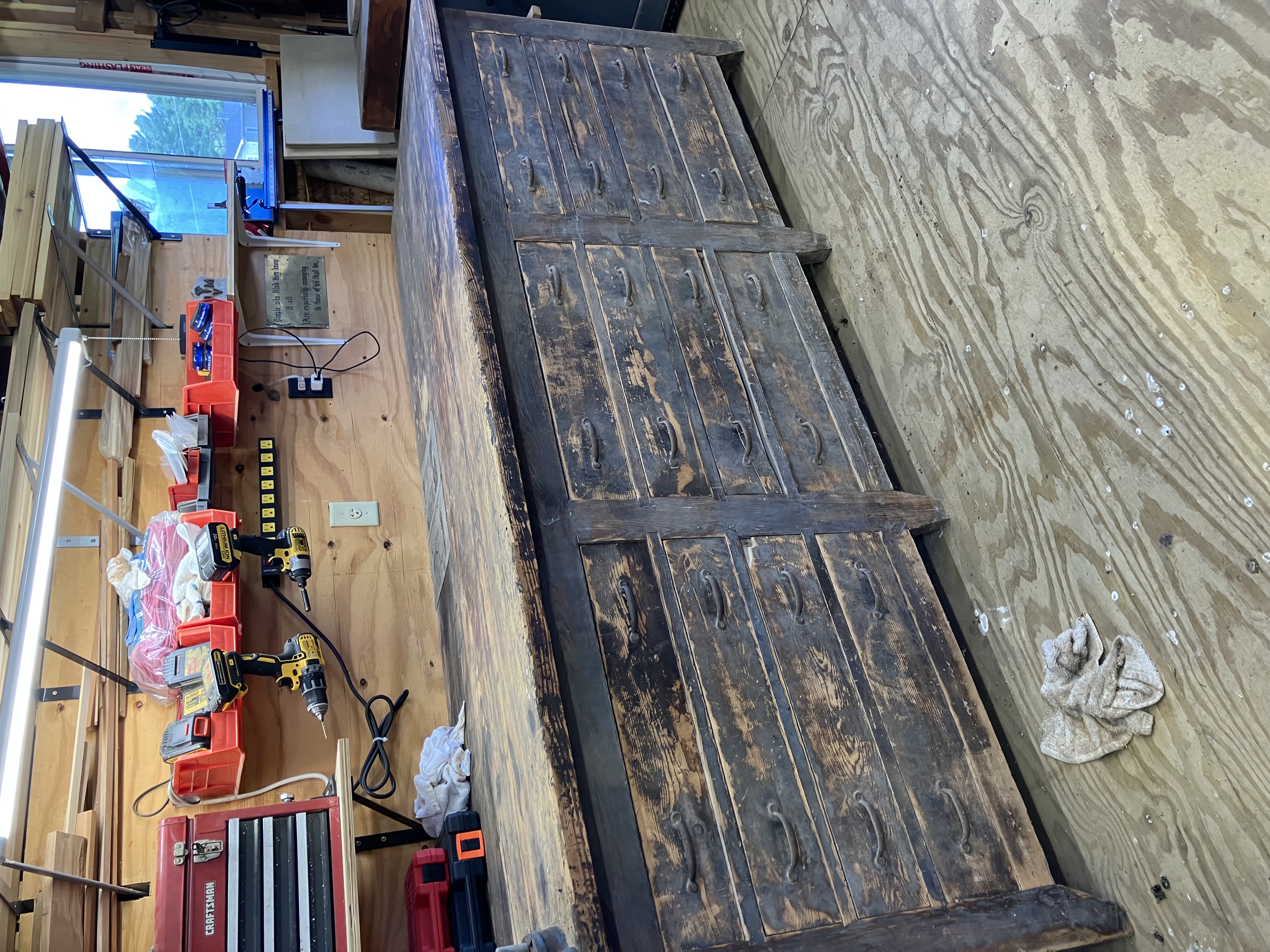
          What you’re looking at in the picture above is my workbench in my barn workshop in West Virginia.  It belonged to my grandfather, L.D. Geiger and has seen a quite a few miles.  It is a full eight feet long, three feet deep, with a two and one half inch thick top and twelve full depth drawers.  It is one of my most treasured possessions.

    Grandaddy Geiger was born near Ybor City in Tampa in 1908.  He was the only son of Mama Byrd (Durrance) Geiger, a woman who came to Florida in a covered wagon from Nebraska in the late 1800’s.  She married a ne’er do well gambler from Geargia, Lorenzo Dow Geiger, and bore him a son, though he wasn’t much of a “home body.”  His fortunes ebbed and flowed, mostly ebbed, as he gambled his way around the southeast and he abandoned Mama Byrd entirely when granddaddy was in the sixth grade.  Years later they heard he had been killed in a knife fight on a riverboat somewhere out of state.  As a consequence of his dad’s conduct, granddaddy was never called “junior” and later in life signed his name as L.D. Geiger, Sr. (my uncle was also named Lorenzo Dow and went by Dow, no “junior” there either).  Mama Byrd lived to be 101 years old.  We celebrated her 100th at the nursing home where she was living in Tampa.  She got a birthday card from President Nixon just a month or so before he resigned.  She wasn’t much of a Nixon fan, more of a Woodrow Wilson gal it seemed.

    After his dad ran off, granddaddy quit school in the middle of the seventh grade to go to work and help support the household.  When he left home he moved toward the center of the state in the area around Avon Park, Zolfo Springs, etc. where he worked whatever jobs he could get from filling station attendant to day laborer.  He met the very petite Mertice Coker and they soon wed.  They scratched out a meager living in Avon Park where they had two children, Dow and Gayle (my mother).  In search of better opportunities, they moved to Leesburg, FL in the early 1940’s.

    At this point you’re wondering what in the Sam Hill (a favorite LD Geiger-ism) does all of this have to do with the workbench?  Patience, I’m getting to that part soon, I promise.  Leesburg / Lake County prospered somewhat during the WWII years with military training bases, pilot training, a POW camp for war prisoners and more.  With rationing in force, things like rubber, leather and other ordinary trade goods, readily available in peace time, were hard to come by.  For instance, you didn’t just go buy a new pair of shoes, you did anything and everything you could to repair and hang onto what you had.  In fact, shoe repair was a very popular neighborhood business and young L.D. Geiger saw this as an opportunity to work for himself for a change.

    He met a fella who was moving away and wanted to sell his little shoe repair shop near downtown.  He was willing to finance it and accept monthly payments if L.D. wanted it.  Granddaddy went and looked it over.  It had a fair inventory and decent tools, but what caught granddaddy’s eye the most was the workbench (see, I told you I was getting to it!).  It was the most stoutly built, well designed bench he had ever seen and he decided it would be worth buying the little shop just to get his hands on it.  The deal was struck.

    Now granddaddy didn’t know beans about shoe repair, but he was quite handy and could figure things out.  He made a go of it for a couple of years until A. S. Herlong (big citrus, land and political figure in Lake County) offered him the position as general manager of an Army Navy Surplus Store (another wartime spawned enterprise) he was opening on Main Street just up from the Coca Cola plant.  Granddaddy sold the shoe repair business, but kept the workbench, of course.  He ended up running Leesburg Army Navy Surplus Store for nearly thirty years until it burned down in 1977.

    He moved the workbench home to a little concrete block shed out behind the house on Floridel Avenue.  That’s where it sat when I was born and throughout my childhood.  He had the drawers filled with an amazing assortment of every conceivable tool, screw, nail, bolt, nut, washer, O-ring, electrical wire, cord . . . there just wasn’t anything you could ever possibly need that wasn’t in one of those twelve big drawers or in the parts cabinets, coffee cans, mason jars and other containers that inhabited the shelves above the bench and around the room.  He never, EVER, threw anything away – you never know when it might come in handy!  He found early on that he could keep his oldest grandson occupied for hours by letting him sort the spare parts and fasteners he collected in buckets.

    He later added a Florida room onto that shed (see, the building permit story) which was, basically, an extension of the roof over the existing concrete slab and screen walls to keep out some of the bugs.  As I grew older it seemed we always found ourselves out at the workbench having a cold coke on a hot day, coffee on a cold morning before a hunting trip, eventually a beer or two while we swapped stories, etc.  Of course, occasionally we actually fixed something too!

    When grandaddy died in 2005 uncle Dow, dad, my brother, Allen, and I all ended up out at the workbench looking at all of the collected tools and stuff.  Uncle Dow had no interest in any of it and commented that he’d have to get a dumpster in to haul it all away.  Dad, Allen and I were horrified!  Not a chance.  We spent a couple of days divvying all of it up between the three of us, tools, parts, assorted fasteners, the works.  The bench was another thing.  Neither Allen nor I had room at our homes for it.  So, dad brought down a horse trailer, we loaded it and put it in his barn at the farm near Citra out near the horse stalls.  It spent fifteen years there until dad died in 2019.  By then it had a good inch or more of accumulated filth caked on it from general dust and dirt, hay, machine oil, animal feeds and medicines, you name it.  A few rats had nested in some of the lower drawers.  It seemed beyond redemption.  But, that’s just not how I was raised.

    I had already built my barn and workshop in West Virginia.  I had built a decent work surface along one wall, but nothing like granddaddy’s workbench.  With help on each end of the journey, I loaded it into a cargo trailer at the farm and hauled it nearly 1,000 miles north to take its place in the spot you see it in the picture.  It took a massive amount of cleaning, scraping and sanding to get it back to where the wood is at least visible.  It ain’t supposed to be pretty, it’s supposed to be ready for work – and is it ever!  Since it’s been there I’ve built several small pieces of furniture on it, executed successful repair operations, and I’ve even written a couple of songs on it.  Roughly 80 years in my family and it’s still going strong.  I love that old workbench and the history it represents.

Want to see my building permit? 

    I freely confess that I have an antagonistic viewpoint when it comes to local requirements for building permits to make improvements to existing structures on your own property.  I regard it as another tax on property for which you are already taxed.  I support the notion of taxes on private property to support necessary local and state government programs, but just tell me how much and then leave me alone.  Don’t keep creating new additional taxes under the guise of a “permit fee” or license.

    I come by that jaded view of building permits honestly.  It was the summer of 1965, I think, and I was sitting on the back steps of my granddaddy Geiger’s house, in town in Leesburg, FL - Floridel Avenue off of highway 27 out near the old skating rink, to be exact.  Granddaddy was stripped to his waist, sweating like a lady of the evening at a Baptist tent revival, laying blocks around the perimeter of an existing concrete slab to construct an outdoor barbecue and sitting area.  Did I mention it was summer?  I’m talking true Florida, scorching hot, suffocatingly humid, blazing sun in a cloudless blue sky, summer.  Not the type of climate conditions that encourage patience and temperate behavior when one is engaged in manual labor.  I knew better than to test granddaddy’s tolerance and I was content to sit on the steps and watch his progress from a distance.

    From around the corner of the house came this skinny fella in shirt sleeves and a black tie.  If Barney Fife had a Florida cousin, this was him.  Some folks might have called him “wormy,” he was so thin and meek looking.  He shuffled nervously out to where granddaddy was working.  “Scuze me Mr. Geiger, I’m from the city building department.  We heard you were building you a Florida room back here and I was sent out, sir, to see if you had your building permit.”  I knew this was going to be good!  

Granddaddy straightened up, pulled a stained handkerchief from his pants pocket, wiped his sweaty face and inspected the little guy much like you would an annoying bug with a magnifying glass.  “Humph!” he said, “yeah, it’s in hanging on my gun rack – would you care to see it?”  The fella from the building department took stock for a moment or two and declared “NO SIR!  I just wanted to be sure you had one!  You have a nice day now.”  And with that he beat a hasty retreat never to be heard from again.  We enjoyed that Florida room, notwithstanding the lack of a building permit, on many an occasion from that summer on until the property was sold after Granddaddy Geiger died at the age of 97 in 2005.
 

That’ll Be Some Picture! 

    Dad was a Lake County farm boy made good.  Two degrees from University of Florida and his DMV from Auburn.  By the time I was in my early teens he was making a good living and we had begun taking vacation road trips to North Carolina each year.  Dad got into photography, which isn’t to say he was really any good at it, but he certainly was good at getting the gear.  He acquired a very nice Minolta 35mm rig with some extra lenses, filters, etc. and would shoot several rolls of film wherever we went.  The mountains of North Carolina certainly provided a target rich environment for an aspiring shutterbug.

    We were at Grandfather Mountain near the swinging footbridge that offers amazing panoramic views.  Not content with the ample photo ops available from the bridge and surrounding area, dad was convinced that a once in a lifetime picture could be had if he stepped over the protective guard rail, slithered on his belly over the rocks out to the edge of the canyon ledge and shot a picture straight down the sheer rock face with his telephoto lens.  This ought to be good!

    Family friend, GZ Smith, was along with us on the trip and was also well equipped with camera gear.  However, he was not sold on dad’s plan and was content to stay back with the rest of us and watch as dad worked his way out to the edge.  As planned, dad went all the way to the edge of the cliff, hung his head and camera out and shot several pictures straight down the canyon wall.  GZ, meanwhile, took several pictures of dad taking the pictures.

    Dad was exhilarated by his death-defying adventure to acquire the ultimate vacation photo and assured us we’d never seen anything like what he would soon show us when the film was developed.  He wound the film back into its sealed spool (surely you remember how that worked) and popped open the back of the Minolta 101 SLR.  To his abject horror he found the compartment empty – in all his planning and preparation he forgot to load film in the camera!  GZ, on the other hand, successfully captured, in sharp focus and the best Kodak color of the day, dad risking life and limb to take a photo while hanging over the edge of a cliff with no film in his camera.  Now THAT’s a picture dad never lived down!
 

Not Going Down With the Ship! 

    This took place outside of Leesburg in Lake County, Florida, back around 1964 or so.  No names have been changed to embarrass the guilty.  Claude Spears was my dad's younger brother by sixteen months and the uncle who I was closest to growing up.  In his first quarter at the University of Florida when he was not quite 18 years old, he dove into the university swimming pool, struck another swimmer and broke his neck.  The accident left him paralyzed from the chest down and he spent nearly two years in rehab (no insurance mind you) before he could return home to the farm near Leesburg.  Though sheer determination, courage and stubbornness, he carved out a life for himself on the family farm and used good ol' cracker ingenuity to make sure he could participate in the usual country boy activities.  Though he was unable to use his fingers, a surgery in rehab gave him the ability to grip with his left hand by cocking his wrist.  This allowed him to use a hoe, hold a fishing rod, etc.  I spent many, many hours hunting and fishing with Uncle Claude and serving as his hands for farm chores.  Summers we were nearly inseparable.

     Not wanting Claude to be limited to fishing the shallow ponds around the farm, granddaddy acquired an Orlando Clipper fiberglass boat with a 60 horsepower Gale outboard motor.  Now, you don't just roll a wheelchair up into one of those.  He had a local handyman create a fiberglass pedestal in the center of the boat and mounted a swiveling bucket seat, complete with seat belt, on it.  Next, we hung a big chain hoist in an oak tree down by the tractor shed.  We'd hoist Uncle Claude up in the tree on the chain hoist, back the boat under him, set him in that bucket seat, buckle him up and roar off to the lake.  If I'm lyin' I'm dyin'!  We'd run 20-30 minutes at 40-60 mph, Claude with his back turned to the wind, waving to whoever might honk or holler as we passed.  What happened if it rained?  Well, Uncle Claude got wet!

     This particular day we were going bream and shellcracker fishing on Lake Harris. southeast of Leesburg, using the old boat ramp off of highway 27.  Dad was driving the truck and was a bit impatient (his normal state back in those days) as we had gotten a late start.  He swung into the parking lot and jumped out, ordering me to hold the bow line of the boat While he backed the boat (and, of course, Uncle Claude) into the water.  I took my designated position and he started the boat down into the water.  All seemed to be going smoothly . . . at first.

     Suddenly, Uncle Claude began screaming in terror!  I'M SINKING, I'M SINKING, YOU DIDN'T PUT IN THE DAMNED DRAIN PLUG!!  There were some other short, vulgar words, phrases and epitaphs in there that I need not repeat.  Water was flooding into the bottom of the boat around his motionless feet through the open drain hole in the transom and Uncle Claude was NOT going to go down with the ship.  You might say he was apoplectic - hollering and waving his arms around like a Saturday morning cartoon!

     What did dad and I do?  Well, it took us a while to get up off the ground and catch our breath from laughing so hard!  You see, it wasn't quite the emergency that Uncle Claude was making out.  Understand, the boat is still hooked to the truck and can't actually "sink" as it is still sitting on the boat trailer on the concrete boat ramp.  All we have to do is pull forward, let the water drain back out, put the plug in (as we should have done in the first place) and all is well.  Uncle Claude did not see it that way.  To say he was not AT ALL amused would be a VAST understatement.  We must have told that story a thousand times at family gatherings over the years and Uncle Claude never laughed once!