
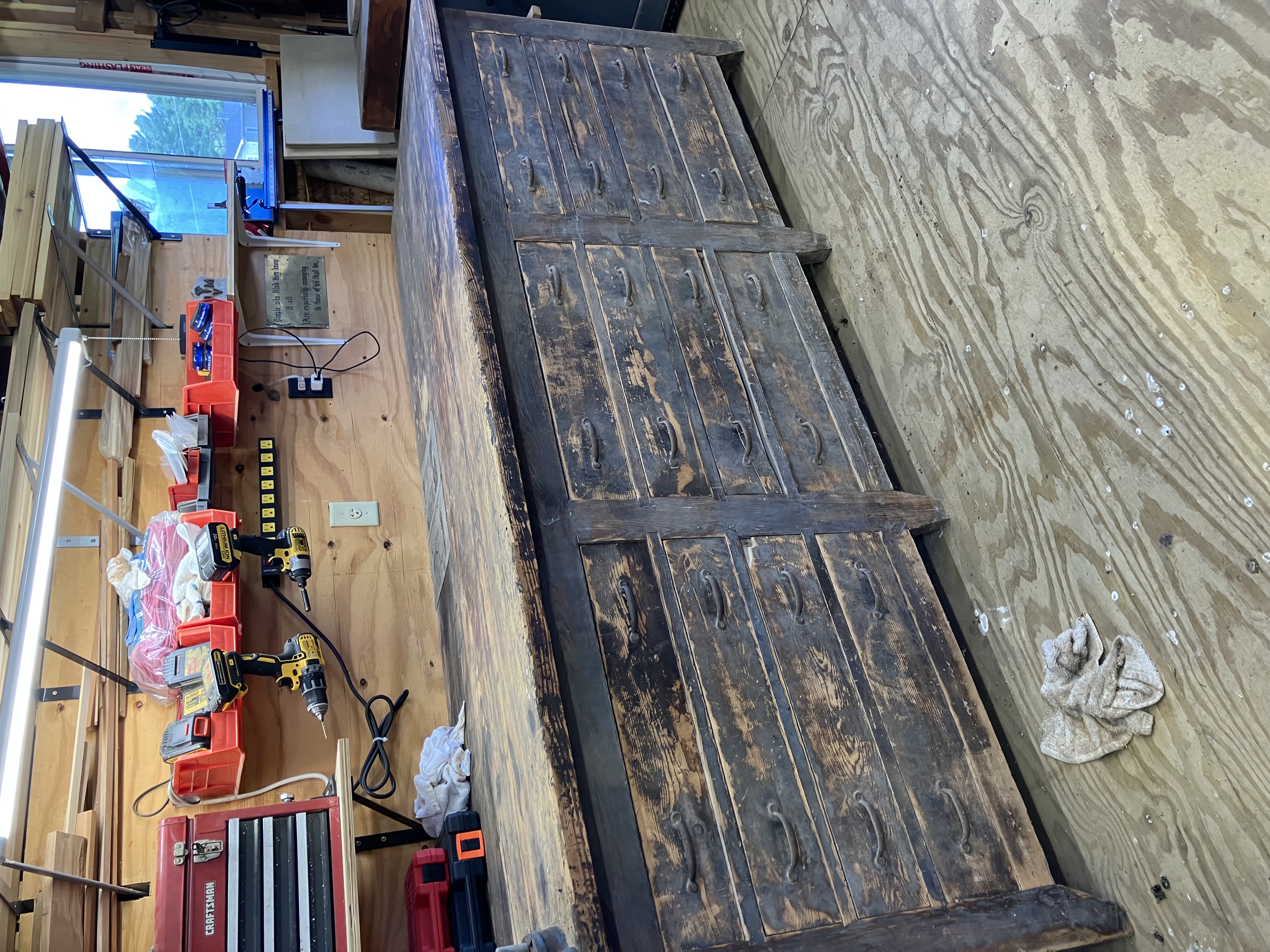
What you’re looking at in the picture above is my workbench in my barn workshop in West Virginia. It belonged to my grandfather, L.D. Geiger and has seen a quite a few miles. It is a full eight feet long, three feet deep, with a two and one half inch thick top and twelve full depth drawers. It is one of my most treasured possessions.
Grandaddy Geiger was born near Ybor City in Tampa in 1908. He was the only son of Mama Byrd (Durrance) Geiger, a woman who came to Florida in a covered wagon from Nebraska in the late 1800’s. She married a ne’er do well gambler from Geargia, Lorenzo Dow Geiger, and bore him a son, though he wasn’t much of a “home body.” His fortunes ebbed and flowed, mostly ebbed, as he gambled his way around the southeast and he abandoned Mama Byrd entirely when granddaddy was in the sixth grade. Years later they heard he had been killed in a knife fight on a riverboat somewhere out of state. As a consequence of his dad’s conduct, granddaddy was never called “junior” and later in life signed his name as L.D. Geiger, Sr. (my uncle was also named Lorenzo Dow and went by Dow, no “junior” there either). Mama Byrd lived to be 101 years old. We celebrated her 100th at the nursing home where she was living in Tampa. She got a birthday card from President Nixon just a month or so before he resigned. She wasn’t much of a Nixon fan, more of a Woodrow Wilson gal it seemed.
After his dad ran off, granddaddy quit school in the middle of the seventh grade to go to work and help support the household. When he left home he moved toward the center of the state in the area around Avon Park, Zolfo Springs, etc. where he worked whatever jobs he could get from filling station attendant to day laborer. He met the very petite Mertice Coker and they soon wed. They scratched out a meager living in Avon Park where they had two children, Dow and Gayle (my mother). In search of better opportunities, they moved to Leesburg, FL in the early 1940’s.
At this point you’re wondering what in the Sam Hill (a favorite LD Geiger-ism) does all of this have to do with the workbench? Patience, I’m getting to that part soon, I promise. Leesburg / Lake County prospered somewhat during the WWII years with military training bases, pilot training, a POW camp for war prisoners and more. With rationing in force, things like rubber, leather and other ordinary trade goods, readily available in peace time, were hard to come by. For instance, you didn’t just go buy a new pair of shoes, you did anything and everything you could to repair and hang onto what you had. In fact, shoe repair was a very popular neighborhood business and young L.D. Geiger saw this as an opportunity to work for himself for a change.
He met a fella who was moving away and wanted to sell his little shoe repair shop near downtown. He was willing to finance it and accept monthly payments if L.D. wanted it. Granddaddy went and looked it over. It had a fair inventory and decent tools, but what caught granddaddy’s eye the most was the workbench (see, I told you I was getting to it!). It was the most stoutly built, well designed bench he had ever seen and he decided it would be worth buying the little shop just to get his hands on it. The deal was struck.
Now granddaddy didn’t know beans about shoe repair, but he was quite handy and could figure things out. He made a go of it for a couple of years until A. S. Herlong (big citrus, land and political figure in Lake County) offered him the position as general manager of an Army Navy Surplus Store (another wartime spawned enterprise) he was opening on Main Street just up from the Coca Cola plant. Granddaddy sold the shoe repair business, but kept the workbench, of course. He ended up running Leesburg Army Navy Surplus Store for nearly thirty years until it burned down in 1977.
He moved the workbench home to a little concrete block shed out behind the house on Floridel Avenue. That’s where it sat when I was born and throughout my childhood. He had the drawers filled with an amazing assortment of every conceivable tool, screw, nail, bolt, nut, washer, O-ring, electrical wire, cord . . . there just wasn’t anything you could ever possibly need that wasn’t in one of those twelve big drawers or in the parts cabinets, coffee cans, mason jars and other containers that inhabited the shelves above the bench and around the room. He never, EVER, threw anything away – you never know when it might come in handy! He found early on that he could keep his oldest grandson occupied for hours by letting him sort the spare parts and fasteners he collected in buckets.
He later added a Florida room onto that shed (see, the building permit story) which was, basically, an extension of the roof over the existing concrete slab and screen walls to keep out some of the bugs. As I grew older it seemed we always found ourselves out at the workbench having a cold coke on a hot day, coffee on a cold morning before a hunting trip, eventually a beer or two while we swapped stories, etc. Of course, occasionally we actually fixed something too!
When grandaddy died in 2005 uncle Dow, dad, my brother, Allen, and I all ended up out at the workbench looking at all of the collected tools and stuff. Uncle Dow had no interest in any of it and commented that he’d have to get a dumpster in to haul it all away. Dad, Allen and I were horrified! Not a chance. We spent a couple of days divvying all of it up between the three of us, tools, parts, assorted fasteners, the works. The bench was another thing. Neither Allen nor I had room at our homes for it. So, dad brought down a horse trailer, we loaded it and put it in his barn at the farm near Citra out near the horse stalls. It spent fifteen years there until dad died in 2019. By then it had a good inch or more of accumulated filth caked on it from general dust and dirt, hay, machine oil, animal feeds and medicines, you name it. A few rats had nested in some of the lower drawers. It seemed beyond redemption. But, that’s just not how I was raised.
I had already built my barn and workshop in West Virginia. I had built a decent work surface along one wall, but nothing like granddaddy’s workbench. With help on each end of the journey, I loaded it into a cargo trailer at the farm and hauled it nearly 1,000 miles north to take its place in the spot you see it in the picture. It took a massive amount of cleaning, scraping and sanding to get it back to where the wood is at least visible. It ain’t supposed to be pretty, it’s supposed to be ready for work – and is it ever! Since it’s been there I’ve built several small pieces of furniture on it, executed successful repair operations, and I’ve even written a couple of songs on it. Roughly 80 years in my family and it’s still going strong. I love that old workbench and the history it represents.